
Captive insurance designed specifically for higher education
The higher education insurance market is changing.
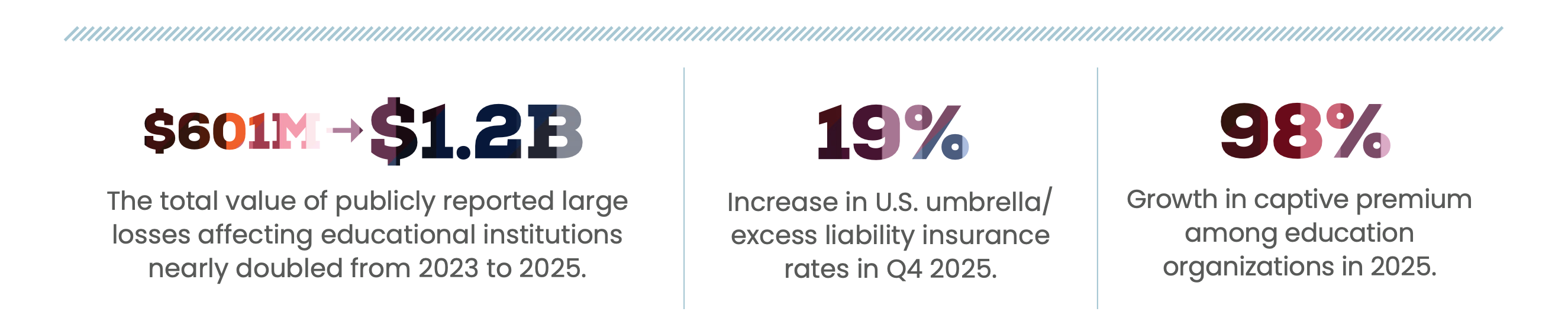
The insurance landscape has become challenging for colleges and universities.
- Rising costs, tighter underwriting, coverage gaps, and emerging risks prompt new thinking on financing and managing risk.
- Year-over-year premium increases put additional pressure on budgets.
- Stricter underwriting means institutions may face higher deductibles, reduced limits, more exclusions, or declined coverage.
- Coverage gaps leave higher-risk exposures difficult or expensive to insure. Increasing claim severity and social inflation create rising liability costs, putting pressure on liability programs.
- Insurance-market consolidation can reduce competition and institutional choice, leaving fewer options.
MHEC’s Sponsored Cell Captive Insurance Program offers a new approach to higher education risk
The Midwestern Higher Education Compact (MHEC) has been a trusted leader in higher education for nearly 40 years, helping the Midwest save more than $144 million in 2025 alone. It established the MHEC Captive Insurance Program to help higher education institutions save time and money. MHEC’s sponsored cell captive offers colleges and universities another way to finance risk—without the cost and complexity of forming their own. Institutions can control costs, customize coverage, fill gaps, and gain greater control. MHEC’s sponsored cell captive offers customization, transparency, and long-term financial resilience where other insurance falls short—and at a reasonable cost. It works alongside existing insurance.
What is captive insurance? An alternative way to finance and manage risk.
- A captive is an insurance company created to insure the risks of its owner or participating organizations.
- Instead of transferring all its risk to commercial insurers, an organization can use a captive to retain and finance a portion of its own risk.
- Colleges and universities can use a captive as a predictable and protective layer while relying on commercial insurance or reinsurance for larger or catastrophic losses.
- A captive gives institutions another tool for managing risk when traditional coverage is costly, limited, or does not fully meet their needs.
- With traditional insurance, institutions transfer both risk and premium to a commercial insurer. With a captive, institutions retain a portion of their risk—and can benefit financially when losses and expenses are lower than anticipated.
- Captive insurance combines the control and flexibility of self-insurance with many of the capabilities of traditional insurance—giving institutions a way to manage risk while retaining greater financial control. A captive can also provide access to reinsurance markets.
How sponsored cell captives work
- Your cell. Your risk. An institution establishes its own legally segregated cell through MHEC’s captive (Stone Arch). It uses that cell to insure one or more layers or lines of risk.
- No shared risk between institutions. Each cell is separate, so one institution’s risk does not affect another institution’s cell.
Multiple coverage possibilities. Institutions can finance a layer of risk for one area or insure multiple lines of coverage.
Frequently Asked Questions
What is captive Insurance?
A captive is an insurance company created to insure the risks of its owner or participating organizations. Instead of transferring all of its risk to commercial insurers, an organization can use a captive to retain and finance a portion of its own risk. For colleges and universities, a captive can complement—not necessarily replace—traditional insurance. An institution might use a captive for a predictable layer of risk while continuing to rely on commercial insurance or reinsurance for larger or catastrophic losses. This gives institutions another tool for managing risk when traditional coverage is costly, limited, or does not fully meet their needs.
How is a captive different?
With traditional insurance, institutions transfer both risk and premium to a commercial insurer. With a captive, institutions retain a portion of their risk—and can benefit financially when losses and expenses are lower than anticipated. Captive insurance combines the control and flexibility of self-insurance with many of the capabilities of traditional insurance—giving institutions a way to manage risk while retaining greater financial control. A captive can also provide access to reinsurance markets.
Why do organizations use captives?
Greater control: Take a more active role in determining how risk is financed and managed, rather than relying solely on the commercial insurance market.
Coverage designed around your needs: Create coverage and terms tailored to institutional risks, including exposures that may be difficult or expensive to insure commercially.
More financial flexibility: Retain a predictable layer of risk, potentially improve cash flow, and keep favorable financial results within the captive rather than transferring the full premium to a commercial insurer.
Access to additional risk-transfer options: A captive can work alongside commercial insurance and may provide access to reinsurance and other risk-transfer arrangements.
Enhanced budget predictability: Help stabilize insurance costs and simplify long-term financial planning by spreading the financial impact of potential losses over time.
Organizations can establish their own standalone captive, but doing so requires significant time, expertise, capital, and ongoing administration. A sponsored cell captive provides another option: an institution can establish its own cell within an existing captive structure, gaining many of the benefits of captive insurance without having to create and operate an entire captive insurance company on its own.
Who can participate?
Any public or private, not-for-profit higher education institution located in a MHEC, NEBHE, SREB, and WICHE member state can participate (excluding South Dakota, which is ineligible to participate, and the three states that do not belong to a higher education compact: New York, New Jersey, and Pennsylvania).
Do we have to leave our existing broker?
No. MHEC’s captive is independent of commercial brokers and insurance carriers and is designed to work alongside an institution’s broader insurance program.
What risks can we insure?
A cell can potentially be used for a range of risks, including but not limited to: workers’ compensation, medical stop-loss, employee benefits, property, casualty, cyber risks, sexual misconduct liability, traumatic brain injury, research-related exposures, and name, image, and likeness (NIL) risks. The specific risks appropriate for a cell will depend on the institution’s needs, loss experience, and program design.
Can we insure more than one type of risk in our cell?
Yes. A single cell can potentially include multiple lines of coverage, allowing an institution to build the cell around its particular risk-financing needs.
Are we sharing risk with other universities?
No. Each cell is legally separate, with its own risks, assets, and liabilities. Losses in one institution’s cell do not become the responsibility of institutions participating through other cells. This separation is one of the key advantages of the cell structure.
How much capital will we need?
Capital requirements will vary based on the risks and coverage placed in the cell. The feasibility and design process will help determine the appropriate capitalization based on the institution’s proposed program and retained risk.
How are premiums determined?
Premiums will be based on the risks insured by the cell and the expected cost of claims and program expenses. Factors such as the institution’s loss history, exposure, coverage limits, and retention structure can affect the amount.
Who handles claims?
Claims administration depends on how the coverage is structured. When a commercial carrier issues the underlying policy, the carrier would generally handle claims. When coverage is provided through a fronting carrier, the front would generally provide claims administration. For excess coverage, the primary carrier typically handles the underlying claim. A purely self-insured program may require a third-party administrator.
Can a cell purchase reinsurance?
Yes. A cell can use reinsurance to transfer a portion of its risk, allowing the institution to retain the level of risk that makes sense for its program while protecting against larger or more volatile losses.
Where is Stone Arch domiciled and regulated?
Stone Arch is domiciled in Vermont and regulated by the Vermont Department of Financial Regulation. Vermont is one of the world’s leading captive insurance domiciles.
Who governs Stone Arch?
MHEC is the sponsor and sole shareholder of Stone Arch. MHEC is governed by a 55-member Commission. Each member state has five appointed commissioners: the governor or the governor’s designee; two legislators, one from each house; and two other at-large members, at least one of whom shall be selected from the field of higher education.
What is MHEC’s role?
MHEC is the captive sponsor. The Midwestern Higher Education Compact and its staff are not licensed insurance agents or brokers and do not provide insurance brokerage services. Stone Arch is a separate legal entity wholly owned by MHEC. Insurance coverage and related obligations are governed by the applicable insurance policies and agreements and are not obligations of MHEC.
What does participation cost?
Fees will vary based on the complexity and number of coverages included in the cell. Contact MHEC for current pricing.
What happens to underwriting profits and investment income?
The cell owner (institution) retains access to underwriting profits and investment income.
How long does it take to establish a cell?
Timing will depend on the complexity of the proposed coverage, availability of institutional data, feasibility analysis, program design, and regulatory approval. The process includes:
1. EXPLORE. Meet with MHEC to discuss your risk-management objectives and explore opportunities where a captive might add value. Learn more about sponsored cell captives and how they could work for your institution.
2. ASSESS. MHEC helps your institution assess how a captive could support your risk management strategy. This step may be brief, or it may include a feasibility study to help evaluate risks, loss history, current insurance costs, potential captive structures, projected claims and expenses, and capital requirements. MHEC can assist with an initial assessment at no cost. More complex feasibility studies may involve a fee.
3. DESIGN. We help institutions determine which risks and layers of coverage will be placed in the cell and establish the program structure, including funding, limits and retentions, service providers, and risk-transfer arrangements.
4. ESTABLISH. MHEC guides you through the process of formally establishing and registering your cell—completing an application, establishing the incorporated cell, obtaining regulatory approval, and capitalizing the cell.
5. LAUNCH. Once launched, MHEC and our captive’s service providers support the institution with management, actuarial, audit, and legal services to promote compliance and long-term sustainability.
What is the first step if we're interested?
Start with a conversation with MHEC. We’ll discuss your institution’s current insurance program, risks, objectives, and potential opportunities to determine whether exploring a captive cell makes sense. Please contact Breanne Hegg, vice president of programs, contracts, and communications, at breanneh@mhec.org or 612-677-2762.