
Insurance Limitations




About this Indicator
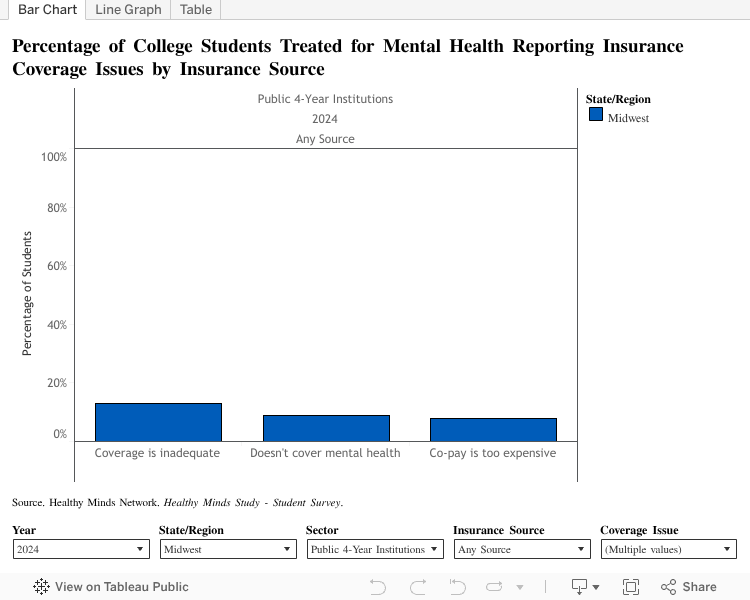
This indicator uses data from the Healthy Minds Study survey to show the percentage of students with past-year mental health treatment reporting whether their current health insurance plan meets their needs for mental health services and if not, why the coverage is inadequate. Accordingly, the sample is restricted to students who received clinical mental health treatment (i.e., counseling/therapy or medication) in the past year and were insured through a health plan. Health insurance plan types were categorized as the following: an individual plan directly from an insurance carrier or through an international student sponsoring agency, parent/guardian or their employer, spouse’s employer, own employer, student plan, or Medicaid or other governmental insurance.
Understanding insurance coverage adequacy is essential for identifying financial and structural barriers that may limit students’ ability to access timely and continuous mental health care. Even when students are insured, gaps in coverage related to cost-sharing, provider networks, or benefit exclusions can discourage help-seeking or disrupt ongoing treatment. Addressing these barriers can support student well-being, academic success, and long-term health outcomes.
Data Source
Healthy Minds Network. Healthy Minds Study – Student Survey.
Note. Students who selected “I am uncertain about whether I have health insurance” or “I have health insurance but am uncertain about where it is from” were omitted from this indicator. The sum of responses can exceed 100% as students were able to select more than one response option. Institutional participation in the HMS is voluntary, self-selected, and periodic, leading to variation in representation across sectors, states, and time. As a result, estimates derived from the HMS survey reflect conditions at specific participating institutions rather than institutions across the entire Midwest or nation. In 2024, 12,689 public four-year students responded to the survey, representing 12 public four-year institutions across six Midwest states: Illinois, Iowa, Kansas, Michigan, Nebraska, and Ohio.
This indicator was developed as part of a collaboration between MHEC and the Healthy Minds Network.