
Price to Income by Race/Ethnicity





About this Indicator
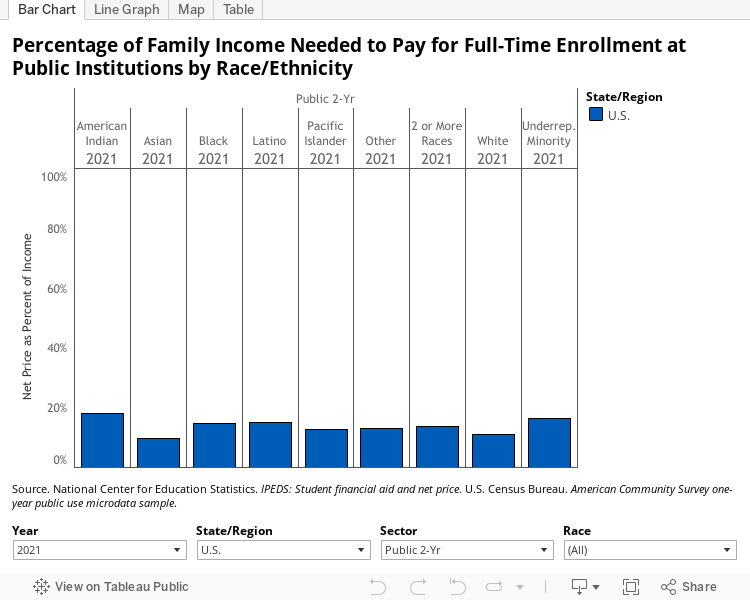
The price-to-income ratio represents the average net price of full-time enrollment at public two- and four-year institutions as a percentage of annual family income. The ratio depicts the relative financial burden of college costs on family resources: higher values indicate that a greater share of family income would be required to cover the average net price.
The average net price by family income is calculated as the total cost of attendance (tuition, fees, books, supplies, food, on-/off-campus housing, and other expenses such as laundry, transportation, entertainment, and furnishings) minus the average institutional, local, state, and federal grant aid for first-time, full-time degree/certificate-seeking undergraduate students who paid the in-state or in-district tuition rate and received Title IV federal student aid. This indicator utilizes median income for families with own children under 18 years old within each racial and ethnic group. The Underrepresented Minority category comprises American Indians, Blacks, Latinos, and Native Hawaiians/other Pacific Islanders.
Data Source
Net price: National Center for Education Statistics. IPEDS: Student financial aid and net price.
Family income: U.S. Census Bureau. American Community Survey one-year public use microdata sample.
Note. Due to sampling problems that occurred during the 2020 administration of the American Community Survey, the 2020 income levels represent 2019 income adjusted for inflation to 2020.